
Tuesday, January 31, 2006


Friday, January 27, 2006

Thursday, January 26, 2006
save gocco!

Oh no..looks like Riso, the Japanese company that makes the awesome Gocco mini screenprinting kits, is discontinuing them. I guess they don't realize how many hipsters (like me) are printing with them. What a bad decision. Luckily, there's a Save Gocco campaign that aims to get another company to pick up the product. Gocco could use some redesign to make it more versatile: right now, it relies on it's own brand of flash bulbs, mini screens, and inks. Dick Blick, Flax, Paper Source, Kate's Paperie, Pearl Paint, anybody! Please save Gocco!
save gocco!
Tuesday, January 17, 2006

Wednesday, January 11, 2006

Thursday, January 05, 2006

Thursday, December 29, 2005

Thursday, December 22, 2005

Wednesday, December 14, 2005

Monday, December 12, 2005
Illustration Friday 12: Blue

My latest illustration friday entry, the topic is blue.
See www.illustrationfriday.com
for more
Monday, November 28, 2005
Solresol: The musical language/La Langue Musicale

Above: Solresol is a language based on the 7 note scale, which was originally d0-re-me-fa-so-la-ti-so
I've been reading about language lately, and I came across a really interesting artificial one called Solresol. If that name sounds vaguely familiar, it's because it's the fifth (sol) and the second note in the standard western musical scale. Back in 1822, Jean Francois Sudre came up with a universal language that could be based on musical tones. The benefits of such a system, if romantic, are interesting. First off, speech would become even more musical than it already is (although perhaps that would lead to nightmares of every conversation sounding like a light opera). The tones (more literal than say, Cantonese tones) already hold suggestions of meanings, and Sudre sought to expand that. For instance, words descending in pitch would have a negative connotation, while affirmative ones would rise in pitch. There are many other fascinating elements to Solresol: if you reverse a word, it becomes an antonym. Also, you can easily apply it to the seven color spectrum (ROYGBIV), thus enabling you to communicate in color. Solresol was a uniquely 19th century creation, born of the age of reason, an ambitious attempt to improve communication. This was the time of the metric system, the French revolutionary calendar, amazing scientific advances, increasing travel, as well as romanticism. You'd have to be quite the dreamer to create a musical language.
Unfortunately, Solresol never really caught on. There are some Solresol speakers around today. I'd love to hear a recording of a Solresol conversation, if anyone has one.
There's also a stenographic script created by Vincent Gajewski, which looks like an interesting geometrically based way to visualize Solresol.
More on Solresol
A Grammar of Solresol so you can start learning!
List of Neographies
Les Dents du Sange/Teeth of the Monkey (1960)

Above: Monkey/devil on a bicycle
Teeth of the monkey (1960)
short film
dir. René Laloux14 min., cut out papers.
To advise: Dr. Jean Oury. Music: Maurice Ohana. Collective realization within the framework of a workshop animated by Rene Laloux in the psychiatric private clinic of Borders at Court-Cheverny.
A dishonest dentist steals the teeth of the poor to resell them to the rich. But the intervention of a mysterieux monkey on a bicycle will put a term at this traffic...
Les Dents du Singe 35 MB .avi file
from the director who later created "La Planete Sauvage", an animated sci fi fantasy with music by funky man Alain Goraguer.
Sunday, November 27, 2005

Thursday, November 24, 2005

Tuesday, November 22, 2005
The Dark Side of the Rainbow: The Wizard of Oz mashed with Pink Floyd's Dark Side of the Moon
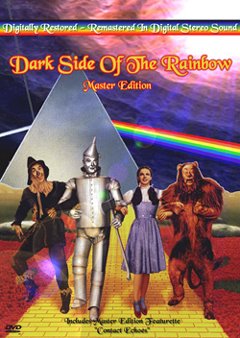
Above: And balanced on the biggest wave
You race towards an early grave.
Wow. I've always loved secrets, conspiracies, rumors light on evidence but nonetheless fascinating. I've blogged previously about the Numbers stations sending out secret cover transmissions-they really exist(ed). I had a book called Rumor! (New York: Penguin Books, 1984. ISBN 0-14-007036-2) back in the day, in which I pondered over the possible satanic imagery on Proctor & Gamble products (false), whether or not Walt Disney had been cryogenically frozen (no), or if porn star Marily Chambers had appeared on the Ivory Snow box (she had). Nowadays a quick trip to snopes.com can settle any urban legend debate, but even quick access to information these days doesn't stop the collective unconscious from birthing strange rumors.
Usually a compelling urban myth combines the normal world with the fantastic in an uncanny way, showing the interconnectedness of the dualities we are so familiar with. So, although the Marilyn Chambers story may sound scandalous at first (what kind of soap company would hire a famous porn star to advertise baby soap?) it's true, and even if the photo was taken before Chambers entered the red-light world, the fable neatly suggests both that Ms. Chambers is not so dirty, and Ivory soap not so pure as they first seem. While the Proctor & Gamble story seems more like industrial slander than real insight, some myths really do hit a chord, and stay with us in various permutations. What starts as rumor becomes urban legend, and will eventually become part of our communal mythology.
One of the oldest myth-types is that of the key to secret knowledge, a code that unlocks extraordinary understanding, and perhaps even a glimpse into the very workings of the universe. This is an important part of the ancient mystery cults, the alchemist's search for the philosopher's stone, all types of numerology, astrology, cryptography, the heroic quest itself.
These pursuits have been and can be tools of sincere metaphysical travel, or the simple tricks of a huckster.
Back in the sixties, the Rock LP became a powerful common cultural experience, and thus it is not surprising to find such esoteric puzzles lurking in them. The most famous one is the elaborate "Paul is Dead" myth, which I think is safe to say, debunked. This myth takes the form of the secret death of a young prince, which three other princes work to conceal from their loving audience. The code was erratic, compelling at times, just fanciful at others. Paul is the only Beatle walking across the Abbey Road cover barefoot-why? Oh well, you see, Paul is the deceased, and the other Beatles are part of a funeral party. Err--riiiight. Anyway, to my young mind this added an interesting sinister undercurrent to an altogether normal band.
What's interesting about these myths is not whether they are true or not. Most of them are patently false if you are talking about objective facts--but all of them hold some kind of emotional or psychic truth. And it is interesting to see how clever people can be in justifying their tales, turning a simple shape into a satanic message or interpreting lyrics either literally, or in a very free way. These myths can deal with rather unimportant matters, like whose picture is on a soapbox, or large historical events, like who killed JFK?, which has spawned many myths.
Finally, what brought me to this is the fascinating "Dark Side of the Rainbow" myth which I recently encountered. Basically, this states that if you play Pink Floyd's Dark Side of the Moon album starting at a certain point in The Wizard of Oz, there are many strange coincidences, audio-visual echoes, and lyrical references. I watched it last night, and this myth isn't breathtaking-you have to stretch your mind a bit. However, it was strangely beautiful to watch the candy-colored fairy tale from the 30s with a 70s band in the orchestra pit. This is a more gentle type of mash-up, where you're not grafting two short, if different, songs together, but instead letting an album and an entire movie drift in and out of sync, in a lovely, nonsensical way. The emergence of this myth makes sense as these two works are among many people's collections and favorites. The point is not whether the album was made to go with The Wizard of Oz-it wasn't. However, they are a beautiful combination. This myth has spawned a search for other movie/album "synchs" like "Contact" with Echoes (another Floyd track)
Monday, November 21, 2005
NYPL Digital Gallery | Library for the Blind: Man with bags of mail

Above: Library for the Blind: Man with bags of mail,
"one days mail, free service, May 1926."
NYPL Digital Gallery | Detail ID 106146
In: New York Public Library Visual Materials > Lantern Slides > Branch Libraries > Branches > Library for the Blind
Library Division:
Humanities and Social Sciences Library / New York Public Library Archives
Subject(s): Lantern slides
Libraries -- New York (State) -- New York
New York Public Library
Notes
"one days mail, free service, May 1926," 5 copies.
Digital ID:106146NYPL Call Number:RG 10
Ricci Adam's Musictheory.net lessons and interactive training

Above: Jelly Roll Morton. Music score for "London Blues." Chicago: Melrose Brothers, 1923.
Music Division, Library of Congress (236A)
I've been studying music theory again. I've always been interested in it, but remained bogged down somewhere between the circle of fifths and the mixolydian mode. I found a great site, Ricci Adam's Musictheory.net which has simple, clear, flash explanations of the basics like pitch, time signatures and scales. Even better, there are interactive apps you can practice with, like an interval ear trainer and a note trainer. I was really happy to find this because I started learning the theory faster than any other way I've tried. And no, this is not an ad for the site--it's free!
Friday, November 18, 2005

The Soft Machine "We Know What You Mean" 22/9/1967, Vitus Studio, Bussum, Holland, Hoepla TV Filming video

Above: Soft Machine at Hoepla: Marc Boyle, Mike, Kevin, unknown, Robert (aka Graham Chapman)
Today's obscure video comes from the Soft Machine. They are another one of those bands that you will hear about, but not actually hear much of. Others in this category include DNA, The Swell Maps, and the Residents. This is the first Soft Machine song I've heard, and I like it. Sounds a lot like Pink Floyd. The song is "We Know What You Mean" and they're performing it live in a tv studio in Holland in 1967. There are some cool oil lamp effects on this one, as well as interesting shots of hipsters dancing, including drummer Robert, who reminds me of Graham Chapman of Monty Python with a little Montgomery Burns thrown in. The audio is a bit hissy, so I didn't post an .mp3, but it shouldn't bother you while watching the video. Enjoy!
The Soft Machine "We Know What You Mean" 28 MB .mpg video
Screen caps on flickr
WE KNOW WHAT YOU MEAN
Words and Music
by Kevin Ayers
What do you know about nothing people?
You sell yourself so you can buy more
What do you care about bluffing people?
Does it make you want to try more?
We know what you mean
We know what you've seen
We understand
What do you care about bluffing people
Throwing sparrows from the treetops
What do you care about nothing people?
When you're waiting at the bus stop
I'm very glad to hear that
We understand the sky will be visible soon
We understand the sky will be visible soon
Soon soon soon you will be obliged to try
Soon soon soon to reach your moon and die
What do you care about nothing people?
You sell yourself so you can buy more
What do you care about nothing people?
And does it make you want to try more?
It's very nice to know
Everybody sing now
An optimistic future
Thursday, November 17, 2005
Threadless T-Shirts - Dark Side of the Garden, by Glenn Jones

Above: Soon, it will be fully operational
Threadless T-Shirts - Dark Side of the Garden, by Glenn Jones
Fantastic T-shirt sale over at Threadless. Have to love it!
Subscribe to:
Posts (Atom)


 Posts
Posts


